ILLUSTRATED ACTIVITY GUIDE 03 · EARLY MATHEMATICS
Count, Sort & Make Patterns
Use socks and large blocks to explore grouping, counting, comparing, and repeating patterns.
Choose an activity ↓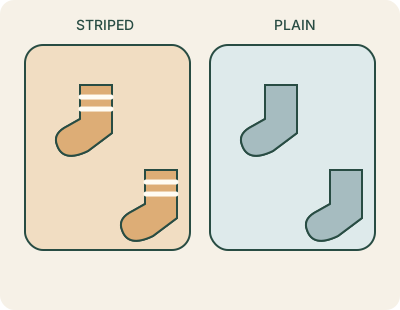
How to use this guide
This guide turns familiar household objects into simple mathematics activities. Start with a small collection and explore one idea at a time. The aim is to notice and talk together, not to race or test your child. You can repeat an activity with the same objects in a different arrangement.
Your role as the adult
Choose large, age-appropriate objects and stay alongside your child. Avoid coins, beads, buttons, batteries, magnets, and other small objects that could be swallowed. Let your child move the objects, or move them according to their directions.
What you’ll explore
Sorting by a chosen rule, counting each object once, comparing groups, and recognizing repeating patterns.
ACTIVITY 1 · 10–15 minutes
Sort a small basket of socks
Two or more groups of socks organized by a rule your child can describe.
What you’ll need
- Four to eight clean socks with some visible differences
- A clear surface or space on the floor
Before you start: Spread the socks out so your child can see them. Start with obvious differences, such as striped and plain socks. If color is difficult to distinguish, use patterns, size, or texture.
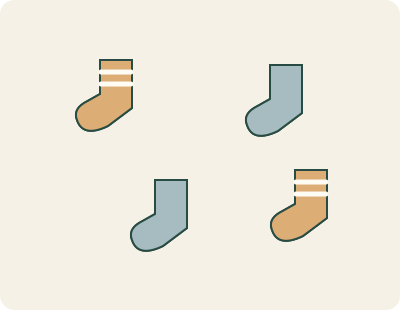
1. Start with four mixed socks.
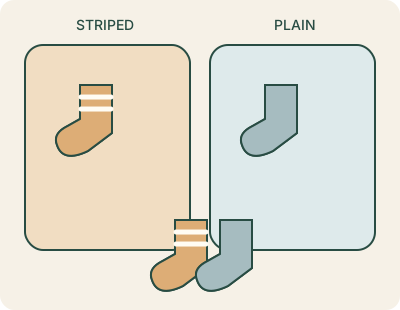
2. Choose a rule: striped or plain.
3. Sort each sock into the matching group.
What to do together
Notice what is different
Look at the socks together. Ask your child to show a pair that look alike and two socks that look different. Describe what you notice without starting to sort yet.
Choose one rule
Agree on a sorting idea: striped socks here and plain socks there, for example. Place one example in each group. Explain that you are using the same rule for every sock this time.
Place each sock
Let your child choose where the remaining socks belong. Ask them to point to or describe the feature they used. If a sock does not fit either group, decide together whether it needs its own group.
Try a different rule
Mix the socks back together. Sort again using size, color, or matching pairs. Notice that the same collection can be arranged in different sensible ways.
Things you can say
- “What makes these socks belong together?”
- “Could we sort this collection another way?”
Make it simpler
Use four socks and two clearly different groups. Place the first sock in each group for your child.
Take it further
Ask your child to sort secretly, then let you guess the rule. They can explain why one sock belongs in a particular group.
ACTIVITY 2 · 10–15 minutes
Count and compare a block collection
A counted collection and two groups you can compare without relying on how much space they take up.
What you’ll need
- Five large, child-safe building blocks
- A clear surface
Before you start: Put five blocks in a loose pile. Use three instead if counting to five is not comfortable yet. Keep the collection small enough to point to each object easily.
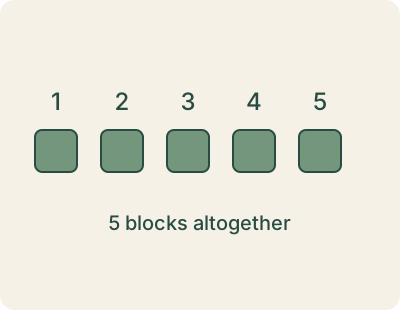
1. Touch each block once as you count to five.
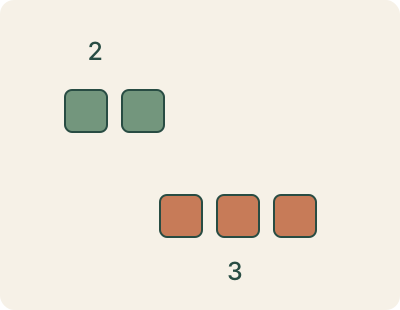
2. Split the collection into two and three.
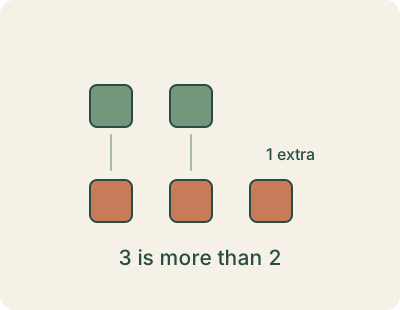
3. Pair the rows to see which group has more.
What to do together
Make a row and count
Move the blocks into a row. Touch or point to each block once while saying one number for it. After the last block, say the total: “One, two, three, four, five. There are five blocks.”
Change the spacing
Spread the same blocks farther apart without adding or removing any. Ask whether there are still five, then count again together to check. Bring them closer and repeat if your child is interested.
Make two groups
Put two blocks on one side and three on the other. Count each group. Ask which group has more, fewer, or whether they are the same.
Check by pairing
Line the two groups up in two rows, matching one block in the first row with one in the second. Notice the extra block in the group of three. Bring all five together and count the whole collection again.
Things you can say
- “Did we add a block, or only move the blocks?”
- “Does every block in this row have a partner?”
Make it simpler
Count three blocks together and let your child move each counted block into a separate space.
Take it further
Start with six blocks and make two equal groups. Invite your child to check that both groups have the same number.
ACTIVITY 3 · 10–15 minutes
Make a repeating pattern
A row of objects with a repeating rule that someone else can continue.
What you’ll need
- Six large blocks in two colors, three of each
- Or six socks: three striped and three plain
Before you start: Use two kinds of objects your child can easily tell apart. You can use texture or shape instead of color. Keep them large enough to handle safely.
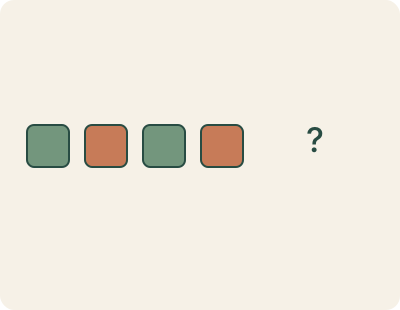
1. Start with green, orange, green, orange.
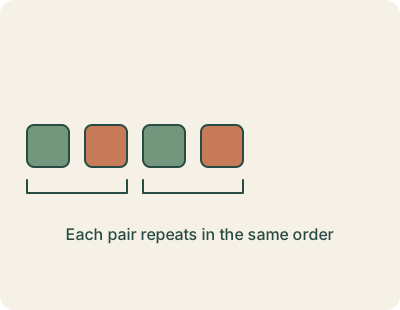
2. Notice the green-and-orange pair repeating.
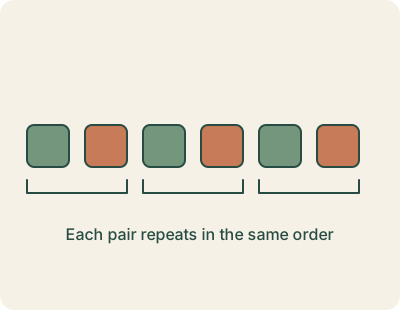
3. Continue with another green-and-orange pair.
What to do together
Start a short pattern
Put down four blocks in alternating colors: green, orange, green, orange. Point to each and say the color, or call them “this kind, that kind” as you point.
Find the part that repeats
Point to the first green-and-orange pair, then the second. Explain that the pair repeats in the same order. Invite your child to say or point through the pattern with you.
Continue the row
Offer the two remaining blocks. Ask what comes next and let your child place it. Then add the last block. Read the whole row together to see whether the same rule continues.
Make a pattern for someone else
Let your child start a new repeating row and invite you to continue it. If you make a deliberate mistake, ask where the pattern changes and let your child help repair it.
Things you can say
- “Which little part keeps happening again?”
- “What would come next? How did you decide?”
Make it simpler
Build just one pair and ask your child to make a matching pair beside it. Say the pattern together.
Take it further
Use a larger collection to repeat green, green, orange. Build that three-object group twice before asking your child to continue.
Stay Playful Project · https://stayplayfulproject.org/play-and-learn/count-sort-and-make-patterns/